
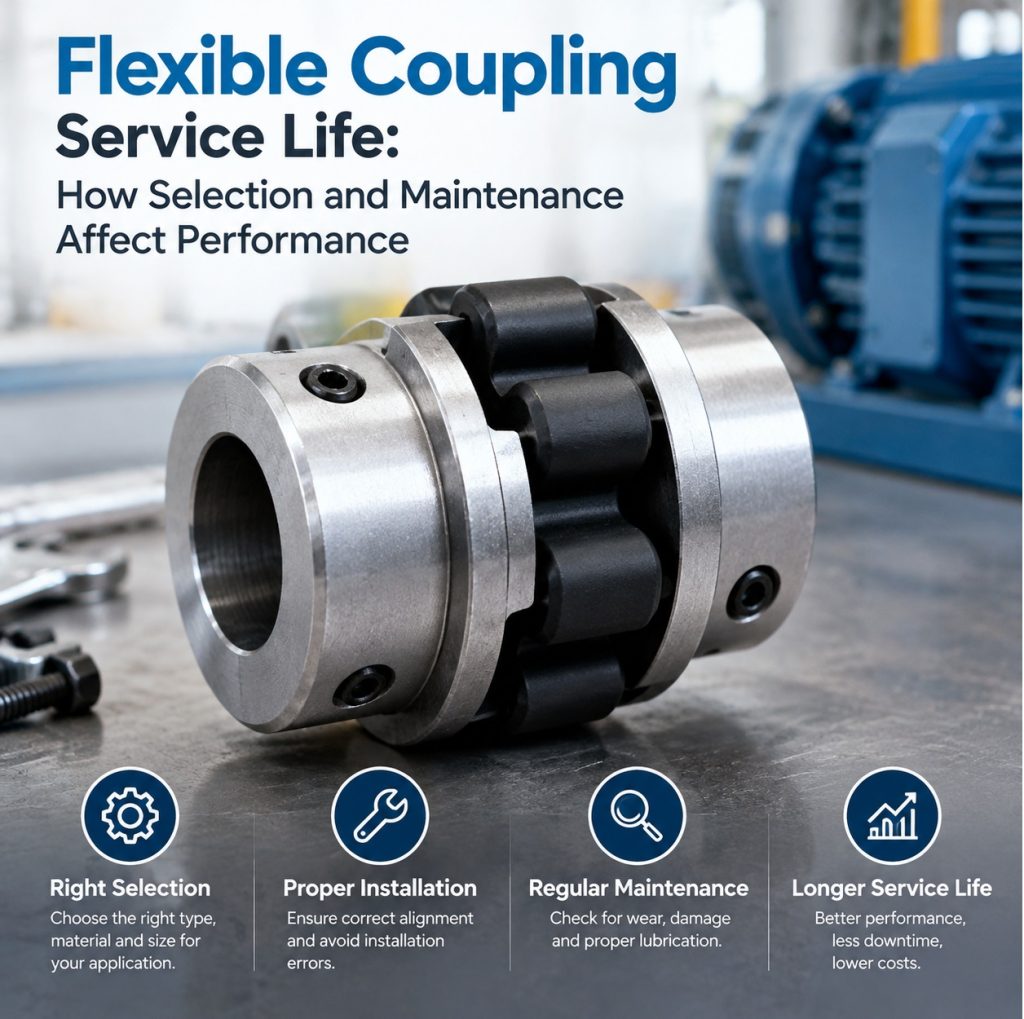
 A coupling that dies at fourteen months instead of fourteen years is almost never a manufacturing defect. It is a decision someone made at a desk months earlier, reading a torque column and picking the third part number from the top.
That is the uncomfortable truth about flexible couplings. They get sold as commodities and treated as afterthoughts, bolted in between a gearbox and a pump the way you would pick a hose clamp. Then they fail, and everyone blames the vendor. Having spent enough time on plant floors, I can tell you where the blame usually belongs.
Start with the selection sheet, because that is where most of a coupling’s service life is either won or quietly thrown away.
The catalog number you want is not the continuous torque rating. It is that rating divided by a service factor that reflects what the machine actually does, not what the nameplate claims. A screw conveyor that starts fully loaded under a pile of wet sand does not care that its nominal running torque is modest. Breakaway torque at startup can run three to four times the running value, and if the coupling was sized on running torque, the elastomer element takes that hit every morning shift. Twice a day, five days a week. That is the whole service life, right there, spent in the first two seconds of each shift.
Reciprocating machinery is worse in a different way. Torque reversals pass through the coupling twice per revolution, and an element chosen purely on peak torque without any thought for fatigue will crack at the spider legs long before a wear limit is ever reached. High-cycle fatigue does not announce itself. It shows up as a sudden, expensive silence.
Misalignment deserves its own discussion, because the industry keeps selling the wrong idea about it. A flexible coupling is not an alignment correction device. It is an alignment tolerance device. It absorbs misalignment, and it charges you for that privilege in heat, wear, and shortened life.
Angular misalignment in an elastomer coupling becomes flexing. Flexing becomes heat. Heat is what kills rubber, and a rough but useful rule of thumb is that every 10 to 15 degrees Celsius above the element’s rated temperature cuts its remaining life roughly in half. That is why a coupling on a hot pump skid inside a poorly ventilated enclosure can look perfectly healthy at commissioning and be crumbling within a year.
Gear couplings handle misalignment differently. They slide. Two sets of crowned teeth, lubricated, working against each other every rotation. That sliding demands a lubricant film that stays where it belongs, which makes seal condition more important than most people want to admit. A weeping seal on a gear coupling is not cosmetic. It is a countdown. Once the grease migrates out and the teeth run metal on metal, you get wear debris, growing backlash, and eventually a sleeve that lets go without warning.
Disc couplings sit in a third category. No lubrication, no elastomer to age, which makes them look maintenance-free on paper. In practice they fail by fatigue cracking in the disc packs when they are pushed past their misalignment limits, or when spacer length and stiffness were specified by someone optimizing for purchase price rather than for how the drivetrain behaves torsionally.
Which brings up the item almost nobody puts on the selection sheet: torsional stiffness.
A coupling is a spring. Choose one that is too soft and you can shift a system’s torsional natural frequency straight into the operating range, which is a recipe for a resonance that destroys gearboxes rather than couplings. Choose one that is too stiff and you transmit shock loads directly into bearings and seals. Backlash matters too. A high-backlash coupling on a positioning axis will show up as lost motion and hunting long before it fails mechanically.
Then there is the environment, the silent assassin. Ozone from nearby electrical equipment attacks natural rubber. Hydraulic oil mist softens certain polyurethane elements. Ultraviolet light through a skylight degrades exposed elastomers over years. Ambient heat, radiant heat from a steam line twenty feet away, and the coupling’s own self-heating all stack on top of each other. If you selected on the datasheet’s maximum temperature instead of the measured surface temperature of the element in service, you are guessing.
Installation is where a good selection gets ruined.
A hub hammered onto a shaft instead of heated or properly fitted distorts its bore and compromises its balance. A key that sits too tall creates a high spot that pushes the hub off center. A runout check skipped at installation becomes a vibration signature nobody can explain six months later. And cold alignment is not alignment. Shafts move when they get hot. If the pump grows upward by 0.15 mm at operating temperature and you aligned it cold to zero, you have just built in a misalignment that runs all day, every day.
High-speed applications add another layer. Balance grade matters, and a half-key balance is not the same as balancing a bare hub. At 10,000 rpm, small eccentricities become large forces, and those forces go into bearings and seals, not just into the coupling.
Now, maintenance.
Gear and grid couplings need lubrication on a schedule driven by duty, not by calendar convenience. Grease compatibility matters, and mixing a lithium complex with a polyurea thickener can turn a healthy coupling into a soapy mess. If your maintenance team is topping up with whatever is on the shelf, your lubrication program is fiction.
Elastomer couplings need inspection, not just replacement after failure. Look for cracking at stress risers, permanent set, glazing, and hardness change. A durometer reading on a removed element tells you more than a visual inspection ever will.
Pay attention to wear limits as well. Tooth wear in a gear coupling, measured as increased backlash, is a trend line. Track it. When it crosses the manufacturer’s limit, the coupling is not still working. It is on borrowed time, and the failure mode is usually abrupt.
Condition monitoring makes all of this easier than it used to be. Axial vibration, housing temperature, and a periodic strobe inspection will catch most common failure paths before they become emergencies. Ten minutes a month with an infrared thermometer is worth more than a binder full of datasheets.
The economics are simpler than people make them out to be. The coupling itself is often the cheapest component in the drivetrain, which is exactly why it gets under-specified. But the cost of an unplanned shutdown, including lost production, emergency labor, and collateral damage to a gearbox or pump, typically runs two to three orders of magnitude higher than the price gap between the right coupling and the cheap one.
So the real question is not how long a flexible coupling should last. It is what you did at the selection table and what you have done since. Get the service factor right, respect the misalignment budget, match the element to its environment, install it properly, and lubricate it on a schedule that reflects reality. Do those things and the coupling will quietly outlive the machine it connects. Skip them and you will be on the phone with the vendor, explaining a failure that was never really theirs.